
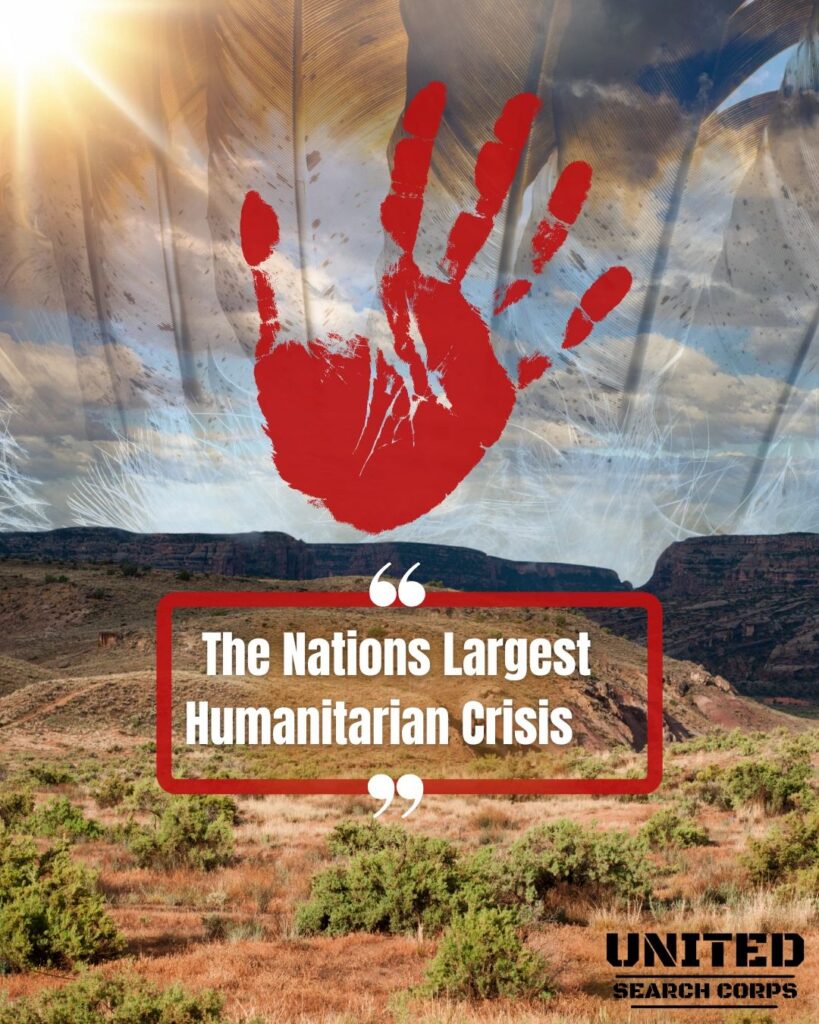
Today, May 5th, is National Missing and Murdered Indigenous Persons Awareness Day. A day that reminds the general public of the urgent and heartbreaking crisis impacting Indigenous communities across the United States. Truth is, today many will hop onto a social media trend, but tomorrow will come and the focus will be diverted onto teacher appreciation or nurses day or apple pie filling. At United Search Corps, this crisis is a year round nightmare that we walk in. While many communities such as black and latino suffer from being under represented and so forth, the indigenous community is enduring a suffering that of which many can not even begin to fathom. This country was founded on immigration and built on the principle of overcoming oppression. All minority communities have rights and protections (albeit flawed) that are afforded to them under state, local and federal law. The Indigenous community does not have the luxury of these same protections.
The difficult truth is that Indigenous people, especially women, face violence and disappearances at alarming rates. American Indian and Alaskan Native women experience murder rates nearly ten times the national average. Yet these tragedies often always fail to make headlines. Stories vanish quietly, cases remain unresolved, and families suffer endlessly, left searching for answers that rarely come. One of the greatest challenges is how underreported and underrepresented these cases are. In 2016 alone, there were more than 5,700 reports of missing Indigenous women and girls. Shockingly, only 116 of these cases made it into the official Department of Justice database. And our experts believe that these numbers only represent approximately 30% of cases. That means there are more than 10,000 Indigenous families left to navigate loss without proper resources, media attention, or law enforcement support. Why? The short and most direct answer is “Unethical Treaties.”
The ancient treaties between Indigenous nations and the United States government have systematically marginalized Native communities, stripping them of resources, land, and autonomy. These agreements have weakened the sovereignty of tribal nations, creating jurisdictional chaos that significantly impedes law enforcement’s ability to investigate crimes effectively. For example, when we (USC) are brought into cases on tribal lands, these cases all suffer from horrific communication and jurisdictional ping ponging. In any case investigation, time is the #1 enemy. That enemy is exponentially more profound within tribal boundaries. While someone’s mother or son or sister is missing or murdered and their perpetrator is getting away, critical time is being wasted determining whether tribal, federal, or state authorities have jurisdiction. This leads to damaging delays, confusion, and cases slipping through the bureaucratic cracks of unethical treaties. At this point, achieving justice or resolution becomes nearly impossible.
With the lack of effective leadership and government, many cases are never even reported and often lead to Indigenous community members being forced to take measures into their own hands. Our organization has seen this on many occasions.
Recognizing this crisis, there have been minimal federal responses, including initiatives started during President Trump’s administration. In 2019, Executive Order 13898 established Operation Lady Justice, which sought to improve coordination among federal, state, and tribal law enforcement agencies. Additionally, the signing of Savanna’s Act and the Not Invisible Act in 2020 marked significant legislative steps forward. These acts improved data collection, mandated better law enforcement cooperation, and created commissions specifically designed to address violence against Indigenous people.
More recently, the FBI has intensified efforts through Operation Not Forgotten, launched in 2023. This ongoing initiative targets unresolved violent crimes in Indian Country, bringing federal resources, including special agents and victim specialists, directly to the frontlines. On May 1, 2025 North Dakota Governor Kelly Armstrong signed House Bill 1199 into law establishing a Missing Indigenous People Task Force. Yes, these steps are commendable and essential, but the fight is far from even getting started. .
At United Search Corps, we know firsthand the importance of persistence and community-driven advocacy. Our mission has always been clear, we search where others have stopped, we amplify voices often unheard, and we relentlessly pursue justice for families who might otherwise remain invisible. Every Native American deserves freedom from the oppression that unethical treaties inflict on a daily basis……………….
https://unitedsearchcorps.org/missing-persons-unit
#MMIP #OperationNotForgotten #UnitedSearchCorps #JusticeForIndigenousCommunities #NeverForgotten